
Mobile IMEI Tracker: What Can IMEI Tell You
Byadmin
What Is a Mobile IMEI Tracker?
A mobile IMEI tracker is commonly associated with the idea of finding a lost or stolen phone through its IMEI number. But there is an important distinction that many people miss: an IMEI number identifies a mobile device, while location tracking depends on separate technologies and network information.
An IMEI, or International Mobile Equipment Identity, is generally a 15-digit identifier associated with a cellular device. It helps distinguish one piece of mobile equipment from another when the device connects to a cellular network.
This creates an obvious question: if the IMEI identifies the phone, can that number also reveal where the phone is?
Not by itself.
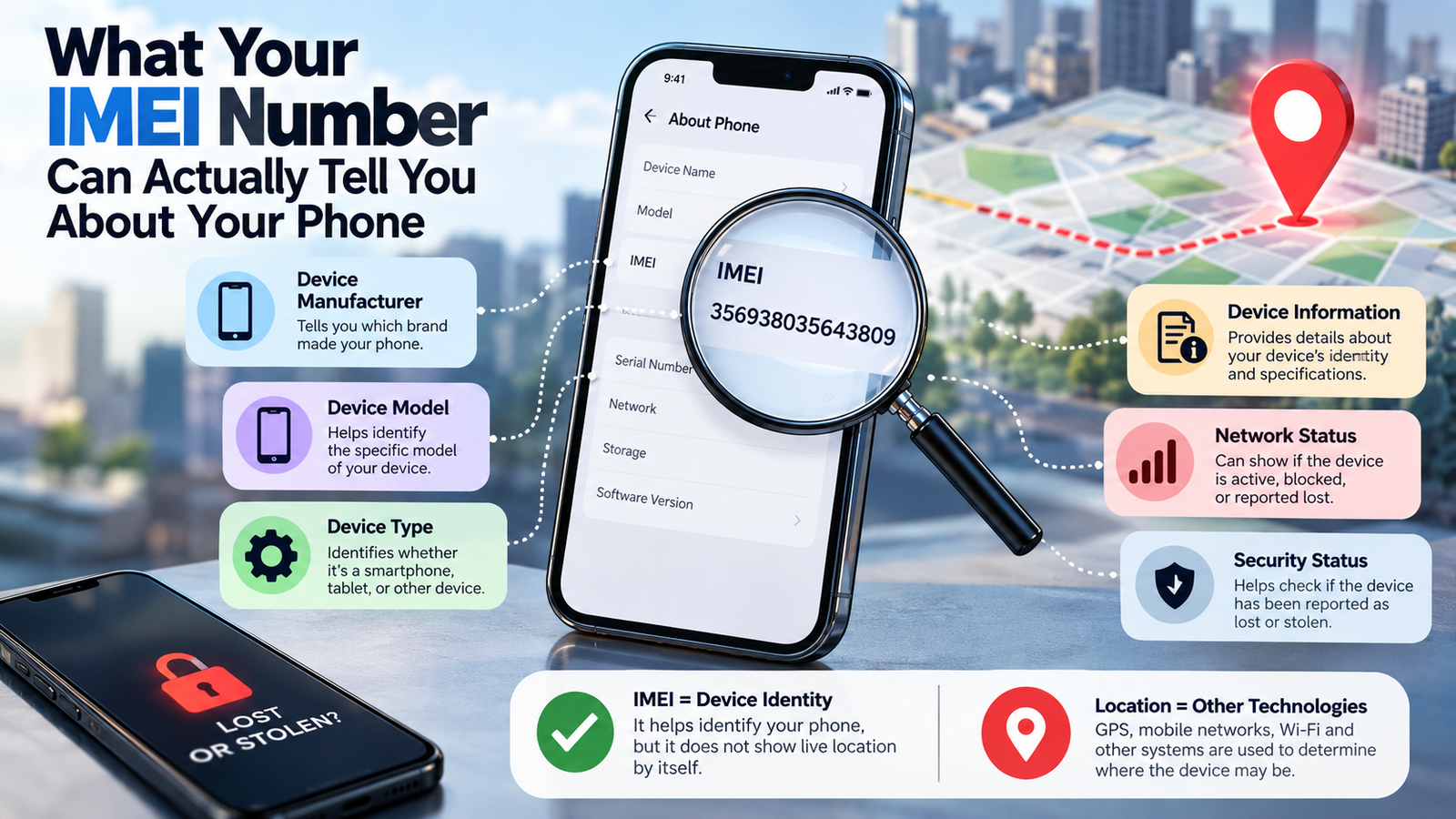
The IMEI is primarily a device identity, not a GPS coordinate. A genuine tracking process may involve device identifiers, cellular network information, location services, and other technical systems working together.
Understanding that difference is important because searches for an IMEI tracker often lead people to expect something much simpler than how real-world device identification actually works.
In this guide, we'll break down what an IMEI number can tell you, what it cannot tell you, how it behaves when a SIM card is changed, what happens when a phone is switched off, and how to prepare yourself before losing a device.
What Exactly Is an IMEI Number?
IMEI stands for International Mobile Equipment Identity.
It is a standardized identifier used to identify cellular mobile equipment.
A typical IMEI contains 15 digits, although the structure behind those digits is more meaningful than simply treating them as a random number.
The number is generally made up of:
8-digit Type Allocation Code (TAC)
6-digit serial number
1 check digit
The TAC is associated with the device model and manufacturer information, while the remaining portion helps distinguish individual devices.
This means an IMEI can provide useful information about the identity of a physical handset.
For example, imagine a store has 100 identical smartphones sitting on a shelf. Their model and specifications may be identical, but each individual device can have its own IMEI.
That is one reason the IMEI is useful for device identification.
IMEI and SIM Card Are Not the Same Thing
One of the easiest ways to understand an IMEI is to compare it with a SIM card.
Your SIM represents your mobile subscription.
Your IMEI represents the cellular device.
For example:
Phone A + SIM A = IMEI A + SIM A
If the SIM is removed and replaced:
Phone A + SIM B = IMEI A + SIM B
The subscription has changed, but the physical handset has not.
This distinction becomes especially important when a phone is lost or stolen.
Changing the SIM does not normally change the device's IMEI.
That's why an IMEI can remain relevant even when the original SIM card is no longer inside the phone.
How Does a Mobile IMEI Tracker Actually Work?
The phrase mobile IMEI tracker can make the process sound like there is a simple database where you enter a 15-digit number and instantly receive a map location.
Real-world device identification is more complicated.
When a cellular device connects to a network, the network can receive device-related identification information. The network can associate the physical device with the mobile subscription currently being used.
Location information, however, comes from other sources.
Depending on the situation, location can involve:
GPS positioning
Cellular network information
Wi-Fi-based positioning
Bluetooth-based finding technologies
Previously recorded device locations
Other network or device signals
The IMEI can answer an important question:
“Which device are we dealing with?”
Location technologies address another question:
“Where is that device?”
Those are related questions, but they are not the same thing.
Can an IMEI Number Show the Exact Location of a Phone?
This is probably the biggest misunderstanding surrounding IMEI tracking.
An IMEI number does not contain a built-in map coordinate.
For example, suppose someone's IMEI is:
356XXXXXXXXXXXX
Those 15 digits do not directly contain:
Latitude
Longitude
Street address
Current GPS coordinates
A live map link
The number identifies the device.
It does not function as an independent GPS transmitter.
In certain investigations, authorized parties may combine device identification with information available through cellular networks or other technical systems. That is very different from an ordinary user entering an IMEI and receiving an exact location.
So, if a service claims that simply entering any IMEI will automatically display the exact live location of the phone, you should examine that claim very carefully.
What Information Can an IMEI Reveal?
An IMEI can be useful for understanding the identity of a mobile device.
Depending on the available database or system, device-related information associated with an IMEI may include details such as:
Device manufacturer
Device model
Device type
Model family
Device identification information
Network-related device status
Whether the identifier has been reported or flagged in a relevant device-status system
However, the information available from an IMEI check depends on the database being used and the authority or access level behind it.
An IMEI should therefore not be treated as a universal key that unlocks every piece of information about a smartphone.
A Simple Example: Two Phones, One Model
Consider a real-world situation.
A retailer receives 500 units of the same smartphone model.
Every phone has:
The same model name
Similar hardware
The same operating system
Similar storage capacity
But individual devices can still have different IMEI numbers.
Now imagine one customer reports that their phone was stolen.
The model name alone would not uniquely identify their physical handset.
The IMEI provides a much more specific device identifier.
This is why recording your IMEI before something goes wrong is useful.
What Happens If Someone Changes the SIM?
Suppose you lose your phone.
Someone finds it and removes your SIM card.
They then insert another SIM.
Does the IMEI automatically change?
Normally, no.
The SIM and IMEI represent different types of identity.
Changing the SIM can change the mobile subscription associated with the device, but it does not normally rewrite the phone's hardware identity.
This is one reason IMEI information can remain relevant when a lost or stolen phone later connects to a cellular network.
However, there are technical exceptions and cases involving tampered or altered device identifiers, so an IMEI should not be treated as an infallible physical proof in every situation.
What Happens When the Phone Is Turned Off?
A powered-off phone creates another major limitation.
If a phone is completely switched off, it is not normally communicating with a cellular network in the same way it would while powered on and connected.
That means an IMEI number cannot independently broadcast the phone's location.
However, modern smartphones may support separate offline-finding mechanisms.
These systems can sometimes use previously stored information or nearby devices and communication technologies to assist with finding a missing device, depending on the device and its configuration.
The important distinction is:
Offline finding technology is not the same thing as IMEI tracking.
The IMEI identifies the device. Other technologies may provide location information.
Can Someone Track You Just by Knowing Your IMEI?
Generally, simply knowing someone's IMEI does not give an ordinary person direct access to their live location.
An IMEI is not a password to a phone's location.
Knowing the number does not automatically provide:
Live GPS coordinates
A person's home address
Real-time movement history
Access to the phone's camera
Access to private messages
Access to accounts
However, that does not mean you should publish your IMEI everywhere.
Your IMEI is a device identifier and should be shared carefully.
Good practices include:
Keep a private record of your IMEI.
Avoid posting it publicly.
Don't share it with random individuals.
Don't combine it with passwords or account credentials.
Use it only when there is a legitimate reason to provide device information.
What Is an IMEI Blacklist?
An IMEI blacklist is used in the mobile ecosystem to identify devices that have been flagged for reasons such as being reported lost or stolen.
Network operators can use device-status information to restrict cellular access to certain devices.
This creates an important distinction:
IMEI blocking is not the same as IMEI location tracking.
Blocking concerns whether a device should be permitted to use a cellular network.
Tracking concerns determining where a device may be.
A phone can potentially be identified or blocked without its exact geographical location being known.
What Should You Do Before Losing Your Phone?
Most people search for their IMEI only after their phone disappears.
That's backwards.
The better approach is to record the information while you still have the phone.
Create a simple device record containing:
IMEI number
Phone model
Serial number, if available
Purchase information
Important account details
Emergency contact information
Store this information somewhere secure.
You can also take a screenshot of the device-information page and store it privately.
This takes only a few minutes but can save considerable frustration later.
How to Find Your IMEI Number
There are several common ways to locate the IMEI.
Use the Dialer
On many cellular phones, entering:
*#06#
displays the device's IMEI information.
Check the Phone Settings
Open the device information or “About” section.
The exact menu can vary between manufacturers and operating-system versions.
Check the Original Box
The IMEI may be printed on the label attached to the original packaging.
Check Your Device Records
Your purchase documents or other device records may also contain the IMEI.
If you still have your phone, finding and recording the IMEI now is much easier than trying to recover it after the phone has disappeared.
Can You Use an Online IMEI Tracker Free?
The phrase online IMEI tracker free is frequently searched by people who have lost a smartphone and want an immediate solution.
But free access does not change the underlying technical limitation.
An IMEI number alone does not magically generate a live GPS location.
A useful IMEI-related service may help with device identification or status information, but that should not be confused with unrestricted real-time location tracking.
Before trusting a tracking claim, ask three basic questions:
What information does the service actually have access to?
Where does the claimed location data come from?
Does the service explain its limitations clearly?
If the explanation is simply “enter your IMEI and see the exact live location,” be cautious.
A technically credible service should explain what its system can actually determine instead of making unrealistic promises.
What an IMEI Tracker Can and Cannot Do
Understanding the difference becomes much easier when everything is placed side by side.
An IMEI-related system may help with:
Identifying a mobile device
Checking device-related information
Supporting device-status checks
Connecting a device identifier with network activity
Supporting lost or stolen device procedures
Helping distinguish individual handsets
An IMEI number alone cannot:
Produce a live GPS location
Reveal an exact street address
Show someone's real-time movements
Access private messages
Unlock a smartphone
Replace location services
Guarantee that a stolen phone will be recovered
This is the most important concept to remember.
IMEI identifies. Location technologies locate.
A Practical Lost-Phone Case Study
Imagine you leave your smartphone in a taxi.
You realize the phone is missing 20 minutes later.
You still have the original box at home, so you find the IMEI and record it.
At this point, the IMEI is valuable because it gives you a specific identifier for your device.
But entering that number alone does not suddenly produce the taxi's location.
Instead, several pieces of information may become relevant:
The phone's device identity
Whether the device is currently reachable
Available location information
Network connectivity
Account security
Device status
Whether the phone has been reported lost
Now imagine the person who found the phone removes the original SIM.
The handset's IMEI generally remains associated with the physical device.
This illustrates why an IMEI is useful for device identification, even though it is not a standalone location tracker.
Why IMEI Cloning or Tampering Matters
IMEI information is designed to uniquely identify cellular devices, but device identity can sometimes be tampered with or duplicated.
This is one reason professionals should avoid treating an IMEI as the only piece of evidence when investigating a suspicious device.
For example, imagine two devices appearing to report the same identifier.
That situation could indicate a problem with the device identity information rather than proving that the two physical phones are actually the same handset.
This is also why reliable device identification can involve multiple pieces of information instead of relying on a single 15-digit number.
Common Mistakes People Make About IMEI Tracking
A large part of the confusion comes from mixing different technologies together.
Mistake 1: Thinking IMEI means GPS
It doesn't.
The IMEI identifies the device. GPS is a positioning technology.
Mistake 2: Believing a SIM change creates a new IMEI
Normally, it doesn't.
The SIM and device identity are separate.
Mistake 3: Assuming a switched-off phone can always be located
Not necessarily.
Device state and supported offline-finding technology matter.
Mistake 4: Sharing the IMEI publicly
There is rarely a good reason to post your full device identifier publicly.
Mistake 5: Trusting every “instant tracker” claim
A service promising guaranteed worldwide live tracking from an IMEI alone should be approached cautiously.
How to Protect Yourself If Your Phone Is Lost
If your phone disappears, the first priority should be protecting your personal information.
Follow these steps:
Try the device's available location and security features.
Lock the device if the available tools allow it.
Protect important accounts.
Contact your mobile provider if necessary.
Keep your IMEI available.
Report the phone as lost or stolen where appropriate.
Avoid confronting someone based solely on a reported device location.
Change important passwords if you believe your accounts may be exposed.
The goal is not simply to find the phone.
It is also to prevent someone else from gaining access to your personal information.
Why Your IMEI Is Worth Recording Today
Your IMEI may seem unimportant when your phone is sitting safely in your hand.
That changes quickly when the phone disappears.
Consider the difference:
Before losing the phone:
You can check the IMEI in seconds.
After losing the phone:
You may have to search through packaging, documents, purchase records, or account information to find it.
That is why keeping a secure record is a small precaution with potentially significant practical value.
Frequently Asked Questions
What is a mobile IMEI tracker?
A mobile IMEI tracker generally refers to a system or service associated with identifying or investigating a mobile device using its IMEI. The IMEI itself is a device identifier, not a standalone GPS tracker. Actual location information may require separate device, network, or positioning technologies.
How can I find my IMEI number?
You can often display the IMEI by entering *#06# in your phone's dialer. You may also find it inside the phone's device-information settings, on the original packaging, or within your device records. Dual-SIM phones may display more than one IMEI.
What is the best way to use an IMEI after losing a phone?
The best approach is to keep the IMEI ready as a device identifier while using the phone's available security and location features separately. If the phone is stolen, provide the IMEI when required during the appropriate reporting or network-blocking process. Do not rely on the IMEI alone as a live-location tool.
Final Thoughts
The term mobile IMEI tracker sounds simple, but the technology behind mobile device identification is more nuanced.
An IMEI is fundamentally about identifying a physical cellular device. It can be useful for device records, network management, lost-phone procedures, and stolen-device investigations.
What it does not do by itself is provide a live GPS location.
That distinction is worth remembering:
IMEI = Device identity
GPS and other positioning technologies = Location information
Once you understand the difference, many of the confusing claims surrounding IMEI tracking become much easier to evaluate.
If you own a smartphone, don't wait until it disappears to find your IMEI. Record it now, keep it somewhere secure, and make sure your phone's available security and location features are properly configured.
A 15-digit number may look insignificant when everything is working normally. But when a device goes missing, having that number ready can become an important part of the recovery and identification process.


Leave a Reply
Your email address will not be published. Comments are reviewed before they appear.