
Can a Phone Be Tracked After Removing Its SIM Card?
Byadmin
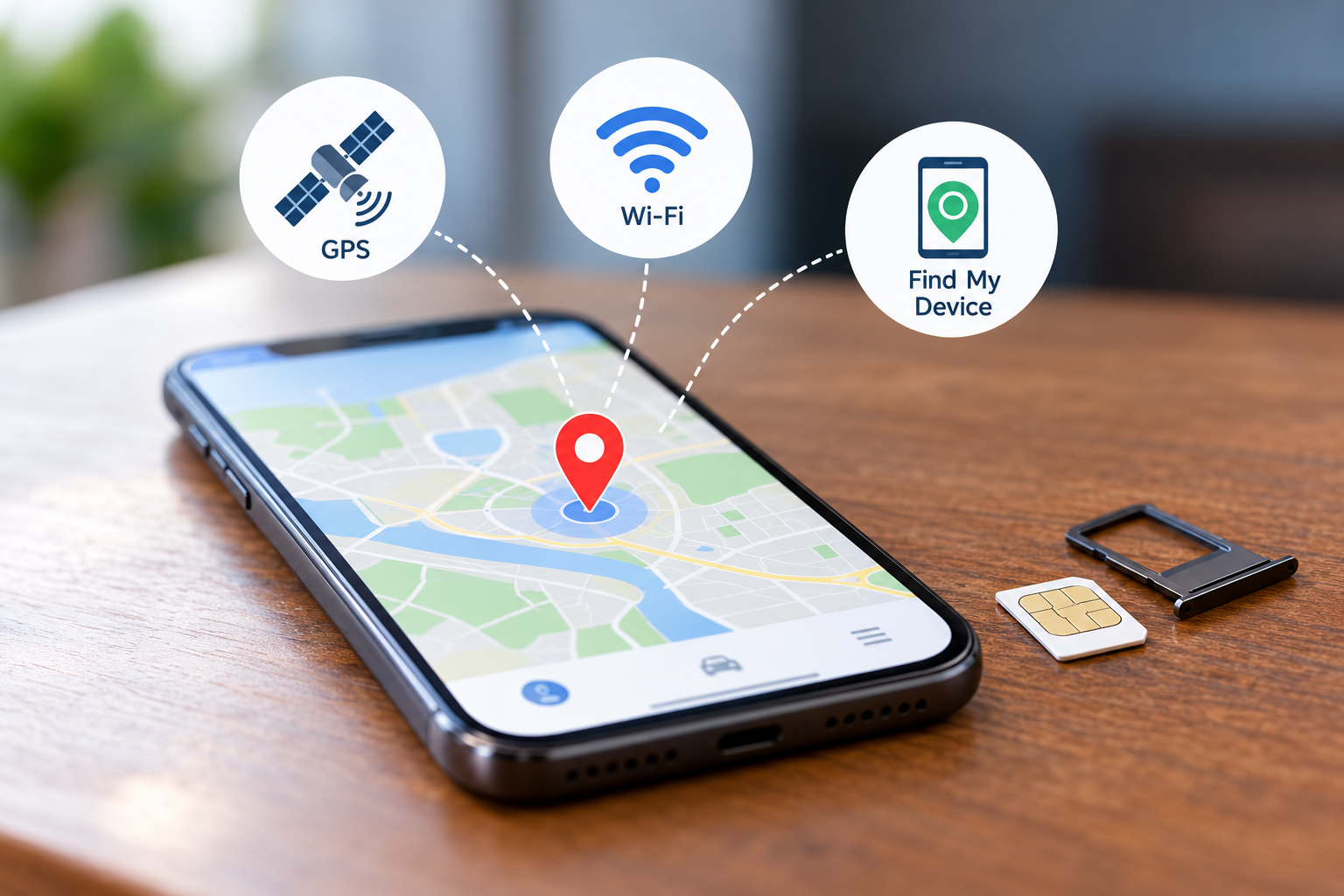
Removing a SIM card does not automatically make a phone impossible to track. A smartphone can still connect to Wi-Fi, use location services, and communicate with certain device-finding networks without an active SIM card. However, accessing SIM number location information depends on the phone's settings, battery status, internet connectivity, and tracking services configured before it went missing.
If your phone has been lost or stolen, you may be wondering whether removing the SIM card prevents someone from locating it. The answer depends on the method being used. GPS can help determine a phone's position, Wi-Fi can provide an internet connection, and built-in recovery services can sometimes display its current or last known location.
This guide explains how phone tracking works without a SIM card, whether police can locate such a device, and what an IMEI tracker can realistically do.
How Does Phone Tracking Work Without a SIM Card?
A SIM card connects a phone to a mobile network through a subscriber account. Removing it generally stops the phone from using that SIM for ordinary cellular service, but it does not disable every wireless feature inside the device.
Phones contain several technologies that can help determine their location or communicate with other devices. These include GPS and other satellite positioning systems, Wi-Fi, Bluetooth, and built-in services designed to help owners recover missing devices.
For example, imagine you leave your phone in a taxi and the driver removes its SIM card. If the phone remains switched on and connects to a saved Wi-Fi network, a previously configured device-finding service may still be able to report its location. If it cannot connect to the internet, the service might show an earlier location or, on supported devices, use an offline-finding network.
The important distinction is that being able to determine a phone's location is not the same as being able to transmit that location to you. GPS may calculate coordinates locally, but an appropriate communication method or supported offline-finding system is needed to make that information available remotely.
Tracking Through GPS and Location Services
GPS helps a smartphone estimate its position using signals received from navigation satellites. A phone does not need an active SIM card simply to receive these signals.
Depending on the device and environment, GPS and other location technologies can help determine where the phone is located. Location accuracy may vary because of buildings, indoor environments, obstructed satellite signals, and other conditions.
However, GPS alone does not allow you to open a website and see the phone's live location. The phone must have a way to share its location with an authorized service or nearby device.
Consider these situations:
SIM removed, GPS enabled, Wi-Fi connected: The phone may determine its position and send location information through an available internet connection.
SIM removed, GPS enabled, no internet: The phone may still calculate its position, but remote access to that information may not be possible.
Phone switched off: Ordinary GPS positioning and location reporting stop. Some supported devices may remain discoverable through specialized offline-finding features for a limited period.
Location services disabled: GPS-based location access may be restricted, although other previously configured finding technologies may still provide information in certain circumstances.
GPS is therefore useful for understanding phone location, but it should not be confused with a complete phone-tracking solution.
Tracking Through Wi-Fi Connections
Wi-Fi is one of the main reasons a phone can remain connected to online services after its SIM card has been removed. A smartphone can connect to a home router, office network, public hotspot, or another available Wi-Fi network without using mobile data.
When a lost phone connects to the internet, compatible services may be able to receive updated location information. This can help an owner check the phone's location using an account-linked recovery service.
For example, suppose your Android phone is stolen while you are travelling. The person who has it removes the SIM card, but the phone remains connected to a previously saved Wi-Fi network. If the necessary account and finding settings are still active, Google Find Hub may be able to locate the device.
Wi-Fi can also help a phone estimate its position by using information about nearby wireless networks. This is different from using Wi-Fi to transmit the phone's location to a remote service.
There are important limitations:
The phone must be within range of a usable Wi-Fi network to connect.
Network may require a password, sign-in, or other authentication.
Phone must remain powered on for ordinary online location reporting.
The relevant account and device-finding features must be configured and available.
A phone without a SIM card can therefore use Wi-Fi for both internet access and location-related functions, but neither guarantees that its current location will be visible to someone else.
Tracking Through Find My Device Services
Built-in device-recovery services are generally the most practical option for locating a lost phone after its SIM card has been removed. They connect a device to its owner's account and use supported location information to help recover it.
For Android phones, Google's service is now called Find Hub. You can access it through Google Find Hub. Sign in with the Google Account associated with the missing phone and select the device you want to locate.
Depending on the device and its settings, the service may display the current location, a last known location, or information from its supported offline-finding network. Some features require the phone to be powered on and connected to Wi-Fi or mobile data, while offline finding depends on device compatibility and prior settings.
For iPhones, Apple's Find My service can help locate a missing device when Find My was enabled before it went missing. Depending on the model, settings, and connectivity, it may show an online location or information obtained through Apple's offline-finding network.
To improve your chances of recovering a phone without its SIM card:
Open the appropriate recovery service on another device.
Sign in using the account associated with the missing phone.
Select the missing device from the available list.
Check whether its current or last known location is available.
If the service supports it, mark the phone as lost, lock it remotely, or display contact information.
Google explains that Find Hub can use encrypted recent locations and a network of nearby Android devices to help locate supported offline devices. Apple also provides an offline-finding network for compatible devices with the relevant feature enabled. These capabilities do not mean every phone can be located at every moment.
For official instructions, consult Google's guide to finding a lost Android device and Apple's guide to locating a lost device.
Can Police Track a Phone Without a SIM Card?
Yes, police may be able to help locate a phone even after its SIM card has been removed, depending on the circumstances, available technical information, and applicable legal procedures. Removing the SIM card does not change the device's IMEI, which is a number used to identify the mobile device.
However, this does not mean police can always obtain a phone's live location immediately. Location information may depend on available network records, device activity, cooperation from service providers, and whether the phone is communicating with a network or another supported finding system.
An IMEI number tracker can be particularly useful when reporting a stolen phone because it helps identify the device. Mobile operators may use the IMEI to block a device from accessing supported cellular networks, subject to the relevant procedures and network capabilities.
If your phone has been stolen, take these steps:
Report the theft to the police and provide the IMEI if available.
Give them the phone's make, model, identifying details, and any relevant purchase documentation.
Use the official recovery service associated with your Android or Apple device.
Contact your mobile operator to suspend the SIM and ask about blocking the device.
Change important account passwords if you believe the phone may be accessible to someone else.
Do not assume that a public website can provide police-level location information simply because you enter an IMEI. Access to telecommunications records and investigative location data is not the same as using an ordinary online checker.
In India, owners of lost or stolen mobile phones can also use the government's Sanchar Saathi portal to access the relevant lost-phone reporting and blocking process through CEIR, subject to the current official requirements. Blocking a device and locating it are separate actions.
What Are the Limitations?
Phone tracking without a SIM card is possible in certain situations, but it is not guaranteed. The result depends on which technologies remain available and whether the phone was configured to support recovery.
Understanding these limitations helps you avoid unreliable services and misleading claims about instant location tracking.
1. No mobile network connection
Removing the SIM card generally prevents ordinary cellular service through that SIM. If the phone cannot connect to Wi-Fi or another supported communication network, it may be unable to send fresh location updates to an online service.
2. GPS does not automatically share location
GPS can help a phone calculate its position, but it does not independently send that position to your computer or another phone. A separate communication or finding mechanism is needed.
3. The phone may be switched off
A powered-off phone cannot normally provide continuous GPS updates or communicate through ordinary Wi-Fi. Certain supported models may remain discoverable for a limited time through offline-finding technology, but this is device-dependent.
4. Tracking services may not have been enabled
If the relevant recovery service was not configured before the phone went missing, your options may be more limited. Some services can show previously stored location information, but they cannot guarantee a new location.
5. Device security and privacy matter
Location access should be limited to devices you own or have permission to locate. Avoid websites that promise guaranteed live tracking from an IMEI alone or ask you to provide passwords, verification codes, or unnecessary personal information.
In short, removing the SIM card makes some tracking methods harder, but it does not automatically disable every way a phone can be found. The most reliable approach is to use an official recovery service, preserve the device's identifying information, and report theft through the appropriate channels.
Frequently Asked Questions
Can a phone be tracked after removing its SIM card?
Yes. A phone may still be located through Wi-Fi, previously configured recovery services, or supported offline-finding networks. Removing the SIM card does not automatically disable these features.
Can a phone be tracked without a SIM card and without internet?
Sometimes. Certain supported devices can be found through offline-finding networks, and some services may show a previously stored location. Without a SIM, internet connection, or compatible offline-finding feature, obtaining a new remote location is much harder.
Does an IMEI tracker work without a SIM card?
An IMEI tracker cannot automatically reveal a phone's live location simply from its IMEI. The IMEI identifies the device, while actual location access depends on available network information, authorized services, and device capabilities.
Conclusion
A phone can still be tracked after removing its SIM card, but the outcome depends on the technology and services available. GPS can help determine its position, Wi-Fi can provide internet access, and official recovery tools may show its current or last known location. Supported offline-finding networks can provide additional options in some circumstances.
If your phone is missing, start with Google Find Hub or Apple's Find My service. If you suspect theft, report it to the police and provide your IMEI. In India, you can also use the official CEIR portal to request IMEI blocking.


Leave a Reply
Your email address will not be published. Comments are reviewed before they appear.